

Before the Green Revolution, Indian farmers grew hundreds of dal varieties. Most of them were replaced. Here is what was lost, and why the old ones cook differently.
The dal you buy from a supermarket today is almost certainly a high-yield hybrid variety -- bred for uniform size, quick cooking, and consistent colour. These are real virtues if you are a processor or a distributor. They are not the same virtues that matter in a kitchen.
What the Green Revolution replaced
Through the 1960s and 70s, Indian agriculture shifted dramatically toward high-yield varieties. For dal crops, this meant replacing regional native varieties with improved hybrids. The trade was productivity for flavour, and it was not a trade anyone really noticed at the time.
What changes when you cook with heritage dal
- —Longer soaking -- 6-8 hours rather than 30 minutes. The seed coat is thicker and more robust
- —Slower cooking -- 20-25 minutes rather than 10. A gentle boil gives better texture than pressure cooking on max
- —More body in the finished dish -- the starch releases differently, creating a thicker, richer dal
- —Earthy, complex flavour that stands on its own with minimal seasoning
A simple preparation
Soak overnight. Drain, rinse. Cook in three times the water with a pinch of turmeric and salt until tender but not falling apart. In a separate pan, heat cold-pressed groundnut oil, add mustard seeds, curry leaves, dried red chilli, and a sliced shallot. When golden, pour over the cooked dal.
The point is not to add more. The point is that you do not need to. A heritage dal, cooked simply, already has enough to be a meal.
FSSAI certified. Traceable to source. No additives.
More from the kitchen

Why your ghee should have an aroma
Commercial ghee is designed to be odourless. That is not a quality standard -- it is a processing decision. Here is what bilona ghee actually smells like, and why it matters.

Turmeric -- sun-dried, not oven-dried
The colour of commercial turmeric is not the colour of the plant. Someone adjusted it. Here is what open sun-drying preserves, and why it shows up in your cooking.
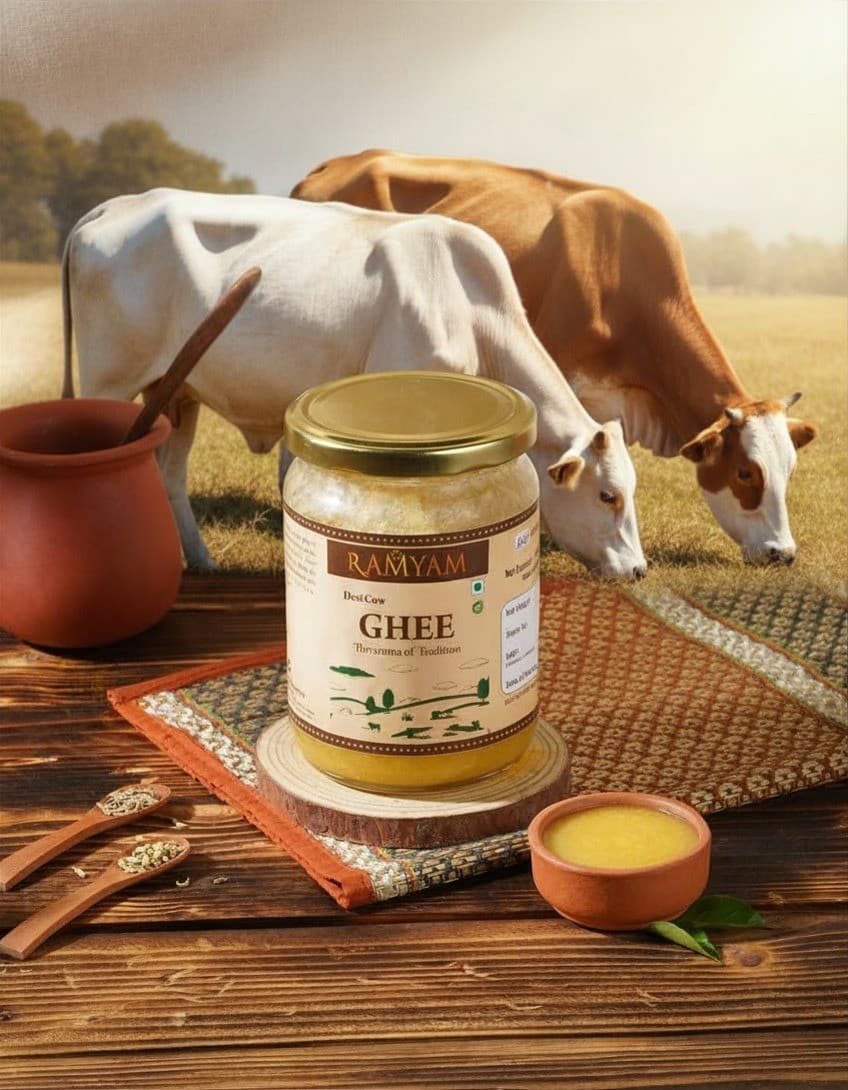
How to make ghee rice -- the RamYam way
A dish where the quality of the ghee is the dish. Two ingredients, one honest pot, and the kind of rice you remember from someone's kitchen.